

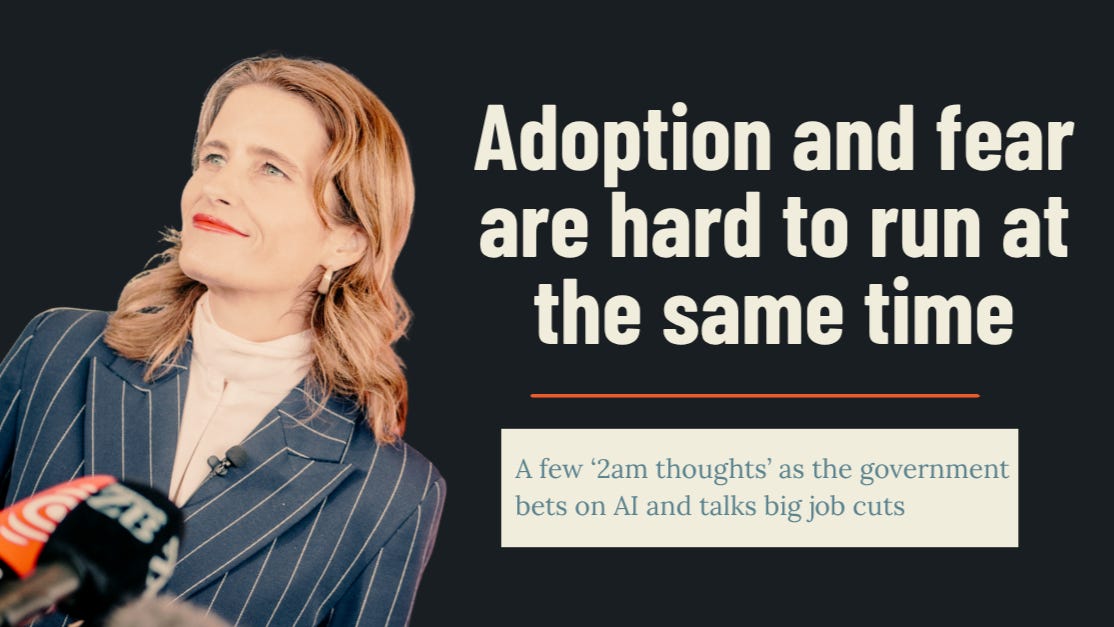
Adoption and fear are hard to run at the same time
In fact, they’re antithetical.

Last year, I sat on an AI adoption panel for the arts and culture sector. The discussion that stuck was the one on social licence: the permission and trust you need to go about your business, especially from the people affected.
I keep coming back to it as the government couples plans to cut nearly 9,000 public service jobs, with making AI deployment a “basic expectation for all public entities“. This is not an uncommon coupling - it’s in the headlines every single day.
For what it’s worth, I use Gen AI and agentic AI most days. I don’t use it to write or do things I think people rely on my experience and credentials for. I use it to run a one-woman band more efficiently and to give me time back. I have defined and automated repeatable tasks. I have organised my bloody folders.
I have always been a pragmatist about new technologies. That doesn’t make me an optimist. This technology is fraught as hell, and people have reasonable and substantial objections, fears and anxieties. If we’re talking about social license for Gen and agentic AI, broadly, it seems this has been skipped or dismissed as unnecessary, but accepting that no social license is required is just swallowing tech-company rhetoric whole. Coupled with a lack of knowledge and strong governance, it’s the blind(ed) leading angry, anxious people with real-world concerns.
A few things I’ve been thinking about at 2am this week, reading the news:
Adoption and fear are hard to run at the same time. In fact, they’re antithetical.
The behaviour you’re hoping to influence - curiosity, experimentation, a willingness to get things wrong and learn - is a big ask while there’s a sword dangling over your head, and it’s even bigger in the public service where failures are front-page news.
A study of 2,257 employees, published this year, found that psychological safety predicts whether people pick up AI tools at all. Fortune published this headline in February: “The AI adoption story is haunted by fear as today’s efficiency programs look like tomorrow’s job cuts.” The cost-cutting, pre-Budget frame is politics, but is it actually helpful?
Social licence runs in two directions
Inwards, with the people asked to use the tools. Outwards, with the public. Concerns aren’t irrational. They sit around ethics, environmental degradation, techno-imperialism, and massive wealth generation for the few, not the many. Practically, they involve data protection, governance and sovereignty, oversight, and who carries the can when something goes wrong. The government’s current AI framework was described as a “Pollyanna policy” in an analysis on The Conversation. The success of Estonia’s Kratt framework, which enables uptake alongside transparency and legal accountability, is predicated on “building the right enablers and governance structures around AI,” according to its government chief data officer, Ott Velsberg.
What people are allowed to use shapes what they think AI is
A recent survey of AI use across the public sector by Adam Jarvis (recommended reading) shows that logically and for many good reasons (risk perception, enterprise agreements), Microsoft Co-pilot is dominant. Adam has an excellent round-up of some of the issues there. Without visibility of the full gamut of publicly available tools - Claude’s Cowork and Code or Google’s Gemini and NotebookLM, for example - your understanding of how they work, and importantly, how your public is engaging with Gen AI, is inhibited. Restrict the tools too tightly, and you get the other problem: “shadow adoption”, with people quietly using personal accounts on their phones, creating the exact data risks the policy was meant to avoid.

The examples you choose when pitching adoption do a lot of work
We didn’t sell social media into business by talking about the bants and the memes. We used stats and examples. “We used AI to help write a report,” or to correct spelling and grammar in speeches, is a rudimentary use case that offers little insight into the potential for broader benefits. Rachel Karten wrote a sharp piece asking, “Does your boss have AI brain?” and included examples of staff who paste their own work into fake Copilot chats so the boss will actually read it. That’s what rudimentary “Gen AI as a chatbot” examples sound like - boss AI brain. Why not cite more sophisticated examples, like the Department of Conservation’s predator-detection cameras or ACC’s AI Scribe (Adam describes it as “likely to serve as the best-practice model for wider adoption over the coming years”, or international examples like the “Kratt” framework.

Words matter because precision is kind of central to Gen and agentic AI use
It’s why I am an annoying pedant and explicitly say Gen and agentic AI. I know it’s shorthand, but “AI” has been stamped on everything from washing-machine fuzzy logic to chess engines for decades. What’s actually being asked for is experimentation with generative AI, LLMs, and agentic AI, and agentic AI is a whole different ballgame from prompting in LLMs. That precision isn’t fussiness for its own sake. The guardrails you need depend on a clear articulation of what you’re talking about and the use cases you envisage and are seeking buy-in for.
The perception of the public service as monolithic laggards
Is it helpful or true? For most people, the story of useful Gen AI adoption is one where they’re enabled, not afraid, and able to experiment, not one where they’re framed as reluctant, unwilling, or so institutionally conditioned that they’re incapable of innovation. The PSA’s survey found 81% of members already say AI helps them work more effectively, with little fear of being replaced. The concerns workers have cited are also pretty valid and universal. Adam’s survey also provides a nuanced look at adoption in the public service.
A pre-Budget, election-year job-cuts framing is inevitable, but it could easily burn the goodwill, innovative spirit, and curiosity that exist. It’s also worth reading Henry Cooke in The Post on what a public servant actually is, the workforce numbers behind it and the “large bet” on AI’s potential.
Thank you for reading the things that popped into my head at 2 am. I don’t have firm conclusions or a wealth of expert knowledge, but I am keen to hear people’s thoughts.